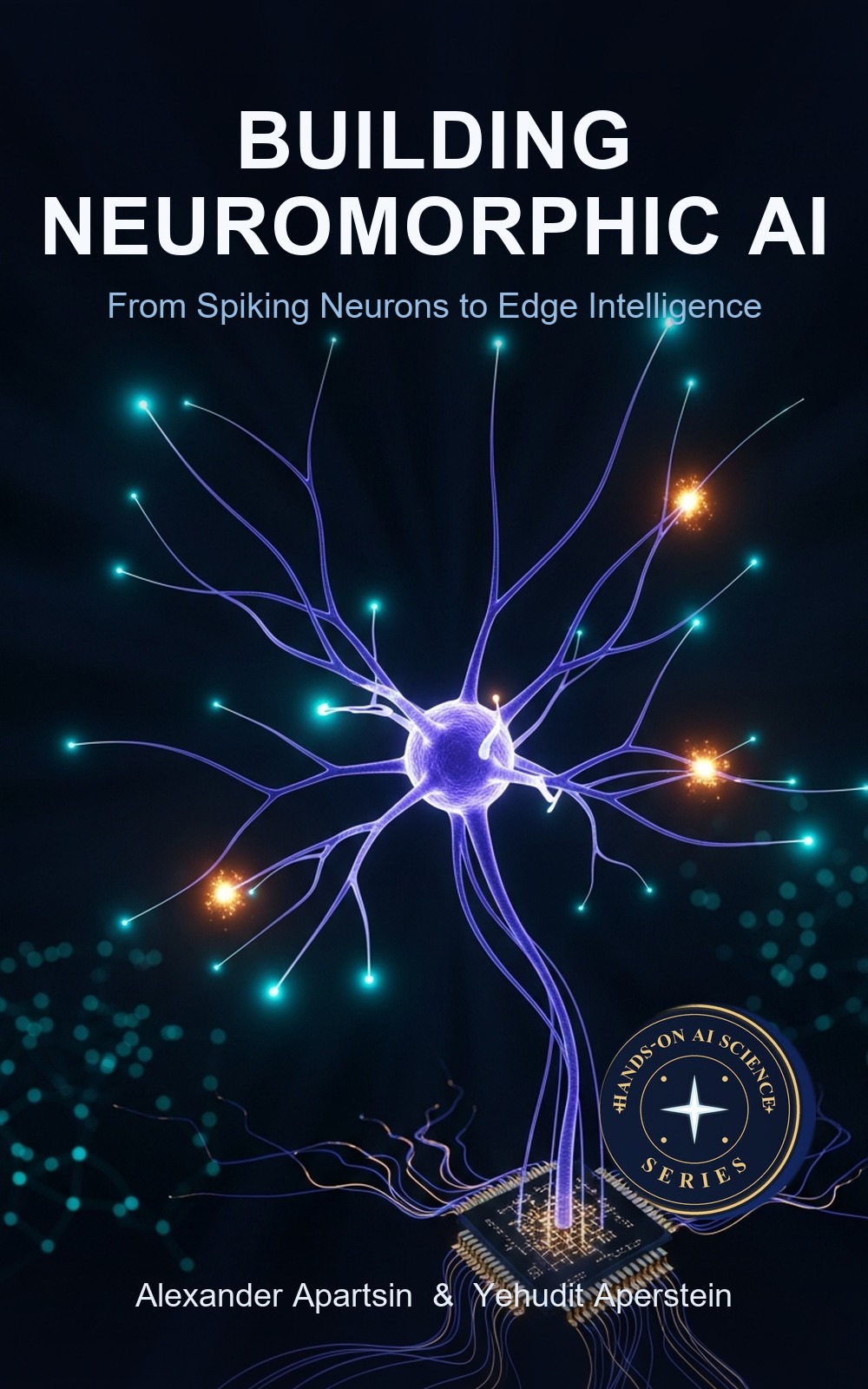
Building Neuromorphic AI From Spiking Neurons to Edge Intelligence
The complete guide to brain-inspired AI: how spiking neural networks work, why they are orders of magnitude more efficient than conventional deep learning, and how to build and deploy them on real neuromorphic hardware.
Neuromorphic AI powers always-on sensors, real-time robotics, and edge devices that cannot afford a cloud round-trip or a large battery. It computes with sparse, asynchronous spikes (the same mechanism the brain uses), making it orders of magnitude more efficient than conventional deep learning for the right tasks. This book covers the full stack: spiking network theory, learning algorithms, Intel Loihi 2 and SpiNNaker hardware, event cameras, and production deployment, from first principles to runnable Python code.
Thirteen Parts, One Continuous Build
From the first spike to a deployed edge system: each part stands on the one before it.
Foundations of Neuromorphic AI
What neuromorphic AI is, why energy and sparsity matter, and how it relates to conventional deep learning. Hype calibration from chapter one.
Ch. 1–5 IIMathematical Foundations
Dynamical systems, fixed points, F-I curves, and population models: the mathematical bedrock for everything that fires.
Ch. 6 IIISpiking Neuron Models
LIF, Hodgkin–Huxley, Izhikevich, AdEx, synaptic dynamics, stochastic spiking, and spike-train statistics.
Ch. 7–11 IVNeural Coding
Rate, temporal, phase, and population coding. Encoding real-world data into spike trains; sparse and predictive coding.
Ch. 12–15 VSNN Architectures
Feedforward, recurrent, convolutional, reservoir, generative, graph SNNs, and hyperdimensional computing.
Ch. 16–21, 64 VILearning in SNNs
STDP, surrogate gradients, e-prop, ANN-SNN conversion, reversible training, RL, continual learning, compression, and deployment.
Ch. 22–31, 65–67 VIINeuromorphic Hardware
Loihi 2, Hala Point (1.15B neurons), SpiNNcloud, Innatera, Akida, analog systems, memristors, FPGAs, and co-design.
Ch. 32–38 VIIIEvent-Based Sensing
Event cameras, event-vision algorithms, stereo and 3D perception, neuromorphic audio, and tactile sensing.
Ch. 39–43 IXApplications
Edge AI, robotics, biomedical monitoring, industrial IoT, autonomous vehicles, and combinatorial optimization.
Ch. 44–48, 68 XHybrid & Foundation Models
ANN-SNN hybrids, spiking Transformers (86.2% ImageNet SOTA), SpikingSSMs, SpikeLLM, SpikingBrain-76B, SpikeMLLM.
Ch. 49–52 XIEvaluation & Benchmarking
Metrics, NeuroBench 2.x, fair energy measurement, the SNN accuracy gap, and explainability of spiking models.
Ch. 53–56, 69 XIIResearch Frontiers
On-chip learning, scaling to billions of neurons, security, theory, neuromorphic photonics, and future directions.
Ch. 57–63 XIIIThe Software Stack
Framework selection, NIR interoperability, performance engineering, reproducibility, AI-assisted development, cookbook, and capstone. The practitioner spine.
Ch. 70–76How This Book Teaches
Six habits, kept in every chapter from the first spike to the last deployed model.
Runnable Recipes
Every chapter contains at least one version-pinned, runnable code recipe: a complete executable pipeline with expected output, never an isolated snippet.
Hype Calibration
Boxes throughout the book teach readers to trace claims to primary sources. “1000× energy reduction” is not accepted without verified benchmarks and a real hardware comparison.
Library Spotlights
After each from-scratch build, a Library Spotlight shows the same task in snnTorch, Norse, Tonic, Sinabs, or NIR, and names exactly what the library handles for you.
Two Reading Paths
The Researcher path builds formal depth from Part I through Part XII. The Practitioner path starts with Part XIII, pulling theory only when a deployment decision requires it.
Open Problems
Each chapter closes with curated open research problems citing specific gaps in the literature, a starting point for thesis topics and research proposals.
Labs & Projects
23 hands-on labs from single-neuron simulation to NIR cross-hardware round-trips. Five final-project tracks for researchers and practitioners.
The Hands-On AI Science Series
Building Neuromorphic AI is one of nine connected books, each a deep, build-it-yourself guide to a major field of AI.
Hands-On AI Science is a series of in-depth guides to the major fields of artificial intelligence. Every book goes deep into the theory, models, and internals, covering the classical foundations and the most recent ideas, then shows you how to build each one in Python with the modern libraries and tools that get the job done. The writing stays plain and light (illustrations, analogies, mental models, worked examples, and a little fun) without trading away rigor or coverage. Each volume is self-contained and complete enough to anchor a full course on its subject.
Building Neuromorphic AI
From Spiking Neurons to Edge Intelligence.
You are hereRead the full About the Hands-On AI Science Series note.